

In this post, I'm offering a new perspective on the un-sung hero of financial planning: the emergency fund. What are the real risks you're facing as an investor, and how having an available amount of cash can help.
Preppers
An underground bunker dug in the backyard. a Lifetime supply of freeze-dried rations, a gun, and bag full of gold coins. That's what Hollywood movies' "preppers" typically stockpile, preparing for one of many versions of the apocalypse; a nuclear winter, a mad max post-apocalyptic world, or, my personal favorite - the zombie apocalypse. Traditionally, it's assumed that if you do have any cash money, you'll be using it to light a fire.
But for the everyday investor, your economic "doomsday" isn't a Mad Max apocalypse and there'll be no zombies chasing you. Rather, it's a severe liquidity shock; a major market correction layered on top of a personal income disruption (tech layoffs, losing a major client).
When it comes to personal finance, Hollywood preppers got it all wrong: In a financial crisis, the world doesn't stop using currency; liquid cash isn't worthless paper, it is your last line of defence against your biggest enemy - you, and the choices you make under pressure.
The Knights of Summer
If you're in your 20's or 30's, or simply started investing in the last 18 years or so, it's very likely you haven't yet lived through a real financial crisis. Worse yet, life might have taught you that what used to be called "a crisis" is merely a bump in an otherwise very pleasant ride, ever stretching up and to the right. Global pandemic? no worries, central banks will flood markets with cheap cash. Trump said something about tariffs? give it a couple of weeks, it'll be fine... In George R.R. Martin's A Clash of Kings, Catelyn Stark looks at a camp of young, untested soldiers boasting and playing tournament games in polished armor during a long peace. She then says:
"Because it will not last... Because they are the knights of summer, and winter is coming."
It's easy to be confident when everything around you signals: "be confident". When screens are green and the market is thriving, it's easy to check a box on a brokerage questionnaire that says "I have a high risk tolerance and will buy more stocks if the market drops 30%". Your armor looks flawless when the sun is shining.
In his 2001 paper, behavioral economist George Loewenstein shows that risk tolerance isn't static; it's high when it's not being test, but it degrades under pressure. Simply put, we tend to overestimate our risk tolerance. The knights of summer are brave, simply because they haven't lived through war. Comes winter, the questionnaire you filled out no longer matters.
Spreadsheets vs. emotions
In financial planning, we optimize for long-term returns, and for a very good reason:
For the average private investor, over time, there's no better choice than equities (stocks). Recent research even shows that a 100% equities portfolio is in-fact your best choice. But that's financial research.
Behavioral research, on the other hand, paints a very different picture: even passive investors (not to mention active investors) don't get the full market's returns;
Morningstar’s long-running "Mind the Gap" research consistently reveals that the average individual investor underperforms the very index funds they own by roughly 1.2 to 1.7 percentage points per year due to poorly timed entries and exits (mind you, as a passive investor, you're really only supposed to have "entries", not "exits", and the word "timed" shouldn't even be in yuor vocabulary, yet here we are). Over a decade, that behavioral friction leaves 15% to 22% of their total potential wealth completely on the table.
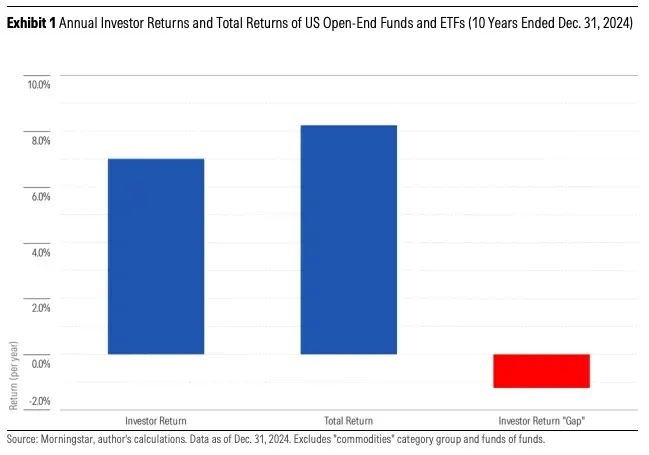
DALBAR's QAIB report shows similar numbers, with a 1.2% gap per year (!) over a 20-year period. This isn't caused by bad funds or bad luck; it’s mostly caused by the lack of a safety net, in the form of a cash reserve.
In Vanguard's "Advisor's Alpha" they estimate that having an advisor can help you achieve 3% per year in added returns. Of that, about 1.5% is attributed to "behavioral coaching". In simple words, it's having a person next to you telling you "don't panic, don't sell". But saying "don't panic" alone is not enough. You to be able not to sell. You need something else to rely on. And if the market downturn is coupled with a personal financial difficulty, that "something" is very obvious:
Hidden returns
While speaking on "The Prof G" podcast, Morgan Housel’s was served a question from a 31-year-old tech worker holding 35% cash out of fear of industry layoffs, despite knowing "on paper" they should invest it. Housel then replied:
"It's what I do. I'm not recommending necessarily that everybody does that but the biggest risk in your personal life and throughout the economy are things that you are not talking about and nobody sees coming; the biggest economic stories in the last 25 years where 9/11, Lehman Brothers going bankrupt, and COVID. And the common denominator of all three of those is nobody saw them coming until the moment that they happened...the only thing that's going to matter for the Investments that you own over the course of your life is whether you can remain invested, when shit gets real...And if having 35% cash means that when the stock market Falls 50% you're able to leave it alone because it's not that big a deal and you have this cash this liquid savings then actually the return on that cache is much much higher than the 3% You're getting in your savings account. If it prevents you from selling and having this unbelievable financial scar from dumping your stocks at the bottom, then the actual return, the implied return, this hidden return that you earn on your cash might be 10 or 20%."
To be fair, Housel can probably afford it, since he has more than enough to do both: invest for the future AND keep this pile of cash to cover all possible "what if's". For the average person, allocating 35% of their net worth to a cash reserve is very costly - the "opportunity cost", meaning, the returns they will not make on this money, are too high. Without those returns, they might not have enough in the future. But the point of his message is: be a prepper. You can't say what's coming. Having a cash reserve is having peace of mind.
Prepping for the (right kind of) apocalypse
In Richard Thaler's Misbehaving, he shows how economists mistakenly consider all dollars to be equal. Theoretically, your portfolio might be big enough for you to withdraw from it in hard times, and still keep calm. But humans don't think that way. he says:
"...But a Human needs buckets. Earmarking an emergency-fund bucket isn't inefficient math; it is a vital pre-commitment device to protect your future self from your current fear."
Having a designated cash reserve is what lets you sleep well when the (financial) world is coming to an end (again). It keeps you calm and allows you to make good choices even when the pressure is on. The emergency fund is by far the most boring part of any financial plan I have ever prepared. It's sometimes frustrating to think of how much returns this amount could generate, if we just let it. But sleeping well at night, and avoiding much more costly mistake, is something worth paying for.
Don't prep for a sci-fi currency collapse where society goes back to the barter system. When financial winter comes you won't need a bunker to hide from zombies. You'll need a safety net, prepared in advance, to protect you from bad choices; from fear, from anxiety. There are no zombies coming. You are the zombie.
Sources
Loewenstein, G. F., Weber, E. U., Hsee, C. K., & Welch, N. (2001). Risk as feelings. Psychological Bulletin, 127(2), 267–286
Aizhan Anarkulova* Scott Cederburg Michael S. O’Doherty (2024). Beyond the Status Quo: A Critical Assessment of Lifecycle Investment Advice