

Panic, greed and the end of days

Updated: Sep 18
With ever-growing concerns regarding company valuations and the chances of a bubble bursting, I'm taking a look at previous instances of crashes, crises and the likes. Unsurprisingly, there's a pattern, and knowing this can help cope with the next crisis, whenever it hits.
Towards the end of The Matrix Reloaded, Neo finally meets "the Architect" - the creator of the matrix. Neo arrives believing he is "The One," a hero tasked with stopping a historic, unprecedented apocalypse that will end human civilization forever.
The Architect then casually says:
"This isn't the first time the system has faced total destruction. It’s actually the sixth"
As investors, when facing a crash, or even just thinking of one, our biggest concern is that this time it is indeed "THE end".
But what If you realize that the world has already "ended" many times before? wouldn't that make you at least a little bit less stressed?
Let's take one step back. When markets crash, why do we freak out?
There are several different reasons for that and they all work together:
"This pain will never end"
Getting sick, experiencing pain, is always unpleasant. But if you're lucky, your doctor tells you when will the pain go away, and when everything "will be normal again". Immediately, it all becomes more manageable.
However, if the doc's honest opinion is "I don't know", this is where you're likely to panic.
Unfortunately, financial crises typically don't come with an end date. There's no one there to tell us we only need to endure this pain for a few more weeks. So we assume the worst: it'll never end.
Fear sells papers
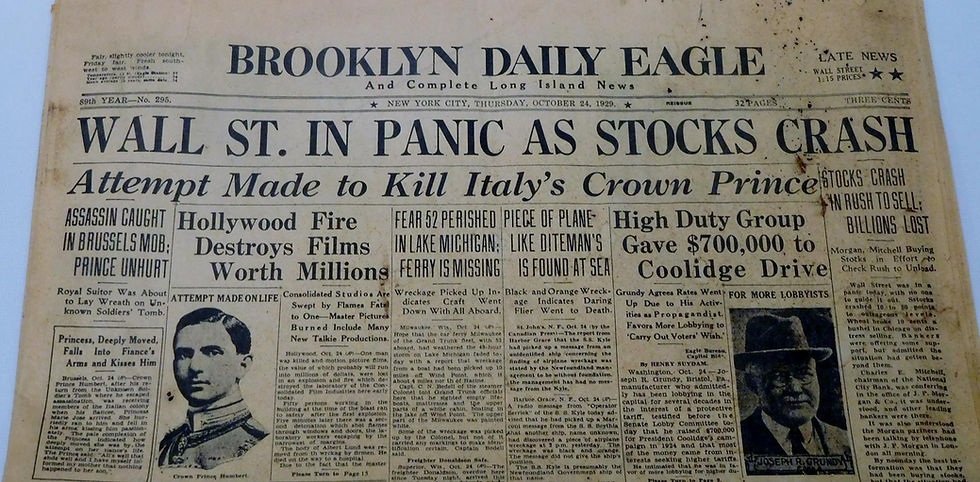
There are those, however, that are more than happy to provide an entirely different type of certainty: the doomsayers, scaremongers and fatalists. Some of them might have a hidden agenda. Others are simply happy telling you "I told you so". But mostly it's much simpler than that: panic used to sell newspapers, now it's being used to sell clicks, but in principle it's the same;
Take the calmest person on earth, show them a headline saying the world is finally, really coming to end (this time for real!), and they will click it.
Even in today's world, where "the internet remembers", journalists, analysts and pundits are hardly ever confronted with their past commentary and forecasts. Some of them are happy to announce the end of the world. If they get to announce it over and over again, that's even better!
This one's for real
As investors, our fear isn't just that a market crash will happen at a certain point (this is almost a certainty). Our deeper fear is that the next crash will also be the last crash. That nothing will ever be the same and that whatever financial plans we have, they will become completely irrelevant.
Realizing that the world has already "ended" multiple times in the past should remind us that, while painful, financial crashes are part of life. And headlines proclaiming the end of days are also not something new - they've been happening for centuries. Let's look at the last 300 years:
Previously, on "The end of the world"
Episode I, 1720 - The high seas
The British "South sea company" plans to trade with South America, only to realize it's Spanish territory, and the Spanish don't like the plan. So they pump their own stock, and It works, until it doesn't. Their stock, which pretty much everyone bought, goes down 80%. The term "bubble" makes its debut in the financial world.


Episode II, 1792 - Bonds. Government Bonds.
William Duer, the former Assistant Secretary of the United States Treasury, learns the hard way that markets go up in the long term, but it's not a smooth ride. He also learns that if you single-handedly crash the market, you go to jail.
Episode III, 1873 - Crazy train
Jay Cooke, a highly-respected banker, sells bonds to finance railroads. Some of those railroads lead where nobody wants to go, and so the bonds go where dreams go to die. It causes a depression so bad people mistakingly called it "The great depression", but only because they haven't seen 1929 yet.


Episode IV, 1907 - Short squeeze
Naughty F. Augustus Heinze and Charles Morse planned to fool everybody but mainly fooled themselves. They created chaos, which led to a run on the banks. The New York Stock Exchange fell 50% and the United States' financial system was eventually saved by a private citizen with no official role, going by the name of J.P. Morgan.
Episode V, 1929 - The leverage of doom
Investors, collectively, wanted to see if investing money you don't actually have is a bad idea and the answer was yes. This answer came in the form of a decade long depression, making the previous "great depression" feel like the good old days you'd like to go back to. The market dropped 89% in total over several years.


Episode VI, 1987 - Black Monday
Life can be very random sometimes. For example when pretty much all Wall Street firms use the same algorithm to automatically sell when the market goes down, which in turn cause more selling and more going down - 22.6% in one day.
Episode VII, 2000 - When "growth" is just a word
Barron's published a story which made people think: "Hold on, If the business model doesn't actually include the "business" part, and there's no profit at all, then...oh f&$k". The NASDAQ collapses 77%.


Episode VIII, 2008 - GFC
When you take a low-quality, risky asset, and package it together with other such assets, you simply get a bigger package of risky assets. This might sound obvious, but many smart and well-paid people chose to ignore that. It pushed the market over a 57% cliff of free fall.
Episode IX, 2011 - Yamas!
Greece isn't really doing too well, but it doesn't want anyone else to know, so they hire the people who are best in the world in making the bad look good. The truth comes out, as it typically does, and crisis erupts. Things are also not that great in Spain, Italy and Portugal, and the Euro almost falls apart. It's so bad that even across the pond, the S&P drops 20%.


Episode X, 2020 - Pandemic
When the price of oil is negative, you know the global economy really hit the brakes. On the positive side, this specific crisis wasn't driven by greed. Still, the S&P 500 dropped 34% in just over a month.
So there you have it. All (or most) of the previous incidents where the financial world has ended.
They happened, they ended, and yet we're still here, and the world, its economy, our lives, have evolved significantly since then.
And this is actually another interesting part: We don't fear past events because they already happened and ended. We tell ourselves how crazy everything must have been, but hey - it's over now. But with future events, we don't have this confidence, and we become pessimistic and scared:
Stories about gradual improvement seldom make the front page even when they occur on a dramatic scale and impact millions of people... Progress is not a news event. Progress is a slow, quiet, and invisible process. A crash, however, is fast, loud, and highly visible. It is much easier to imagine destruction because it happens all at once, whereas adaptation requires us to think about a future we cannot see.
Hans Rosling, "Factfulness"
I'm writing all of this because I was asking myself a simple question: "How to help investors remain calm and react more wisely to a crash, which comes at an unknown timing and magnitude".
In a previous post I already wrote about the more practical side of it. With this one, I mostly wanted to provide some context. We need to remind ourselves that this has happened before, and will happen again. I don't know when, and I'm not trying to guess. But we all need to accept it.
My daughter asked me when she came home from school, “What’s the financial crisis?” and I said, it’s something that happens every five to seven years.
Jamie Dimon, JP Morgan CEO
Whenever it hits, remember: we've been here before.
Stay calm
.


Comments