
TL;DR
- Employees pay 9.3% of their gross salary into the state pension, and employers add another 9.3%, up to the contribution ceiling (€101,400 in 2026).
- Each year earns pension points: your salary divided by the average salary, capped at roughly 2 points a year.
- At retirement, your total points times the pension value (currently €42.52 per point) give your gross monthly pension.
- The system is pay-as-you-go: contributions aren't invested, fewer workers support each retiree, and federal subsidies keep growing. Measured as an investment, it typically returns less than inflation.
The German state pension scheme is a point-based, pay-as-you-go system. Though contributions are high relative to your gross salary, the system unfortunately has many weaknesses.
First, let's explain the mechanics and how it works:
How much do you pay in?
The short answer is: A LOT.
9.3% of your gross salary is deducted for this purpose, and your employer adds their part as well, which is ANOTHER 9.3%. So 18.6% of your gross salary. If you're making €5,000/month gross, that's €930/month, or €11,160 annually.
What is a point-based system?
In essence, you collect points by contributing into the system. The formula for collecting points is quite simple: a full year of employment, at exactly the average gross salary as calculated for that year, grants you a point.
Up to a certain cap, it's proportionally calculated:
- 6 months of work, 1 x the avg. salary = 0.5 points.
- 12 months of work, 1.5 x the avg. salary = 1.5 points.
and so on.
The annual point accumulation cap
Points are accumulated proportionally based on your gross income, but only up to the contribution ceiling (Beitragsbemessungsgrenze), which is roughly twice the average gross income in that year. If you earn more than that, you will not deposit more into the system beyond that cap.
It's worth noting that the calculation is made on an annual basis. If you earned 3 times the average salary in one year, and nothing in the following year, you'll accumulate a maximum of roughly 2 points (for the 1st year) and nothing in the 2nd year. There's no long-term average or cross-year calculation.
In certain aspects, it makes high-earners even worse-off, but that's for later.
Here's an example of a person starting to work in Germany in 2022 and how they will accumulate points, based on their gross salary and where it stands compared to the average gross salary in each year:
| Year | 2022 | 2023 | 2024 | 2025 |
|---|---|---|---|---|
| Average Salary in Germany | 42,053 | 44,732 | 47,085 | 49,147 |
| Example Salary | 47,500 | 60,000 | 110,000 | 128,066 |
| Avg. Salary Multiplier | 1.13 | 1.34 | 2.34 | 2.61 |
| Points accumulated | 1.13 | 1.34 | 1.92 | 1.97 |
Source: average salary (Durchschnittsentgelt) as set for the pension insurance in Anlage 1 SGB VI. In 2024 and 2025, the example salary is above the contribution ceiling (€90,600 and €96,600), so the points are capped at the ceiling divided by the average salary.
How will your allowance be calculated?
Once you retire, the total amount of points you've accumulated throughout the years will determine the amount you'll receive every month. The calculation is simply a multiplication of your total points by a so-called "pension point value" (aktueller Rentenwert).
At the time of writing this, in September 2026, a single point is worth €42.52.
If you've accumulated a total of 40 points, your monthly gross allowance will be:
40 x 42.52 = €1,700.80 monthly.
The value of each point is updated annually, in July. While the factors used for calculating the increase are not directly based on inflation, the idea is that the value of the monthly allowances will be able to keep up, at least partially, with rising prices.
Key weaknesses
Much has been said and written about the weaknesses that are inherent to the system's current form. In principle, it boils down to two key issues:
Not self-sustained
In the past, a simplistic system like this made perfect sense. As long as the population grows, there are always more working people contributing into the system than retirees receiving allowances. But with life expectancy increasing, dropping birth rates and the resulting aging population, this simple principle just doesn't work anymore.
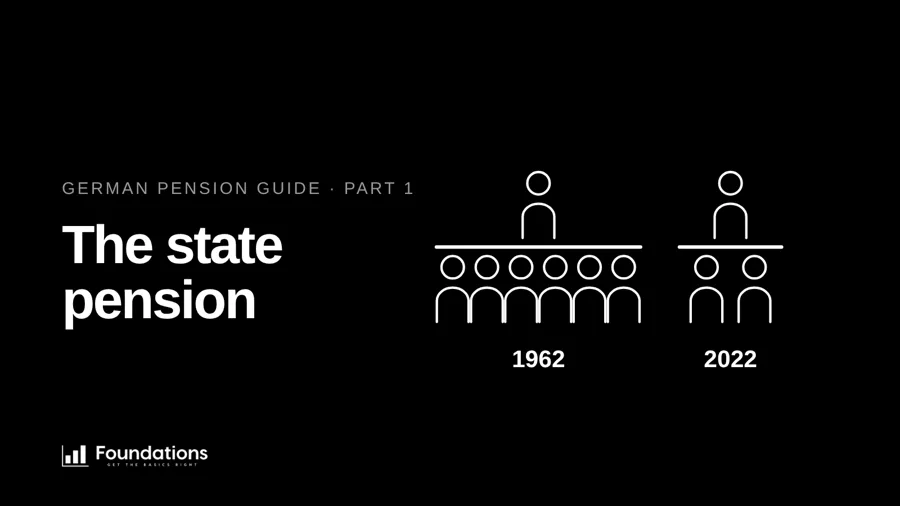
The chart below shows it clearly: in 1962, there were more than 6 working people for every retiree, but in 2022 this number dropped to just over 2:
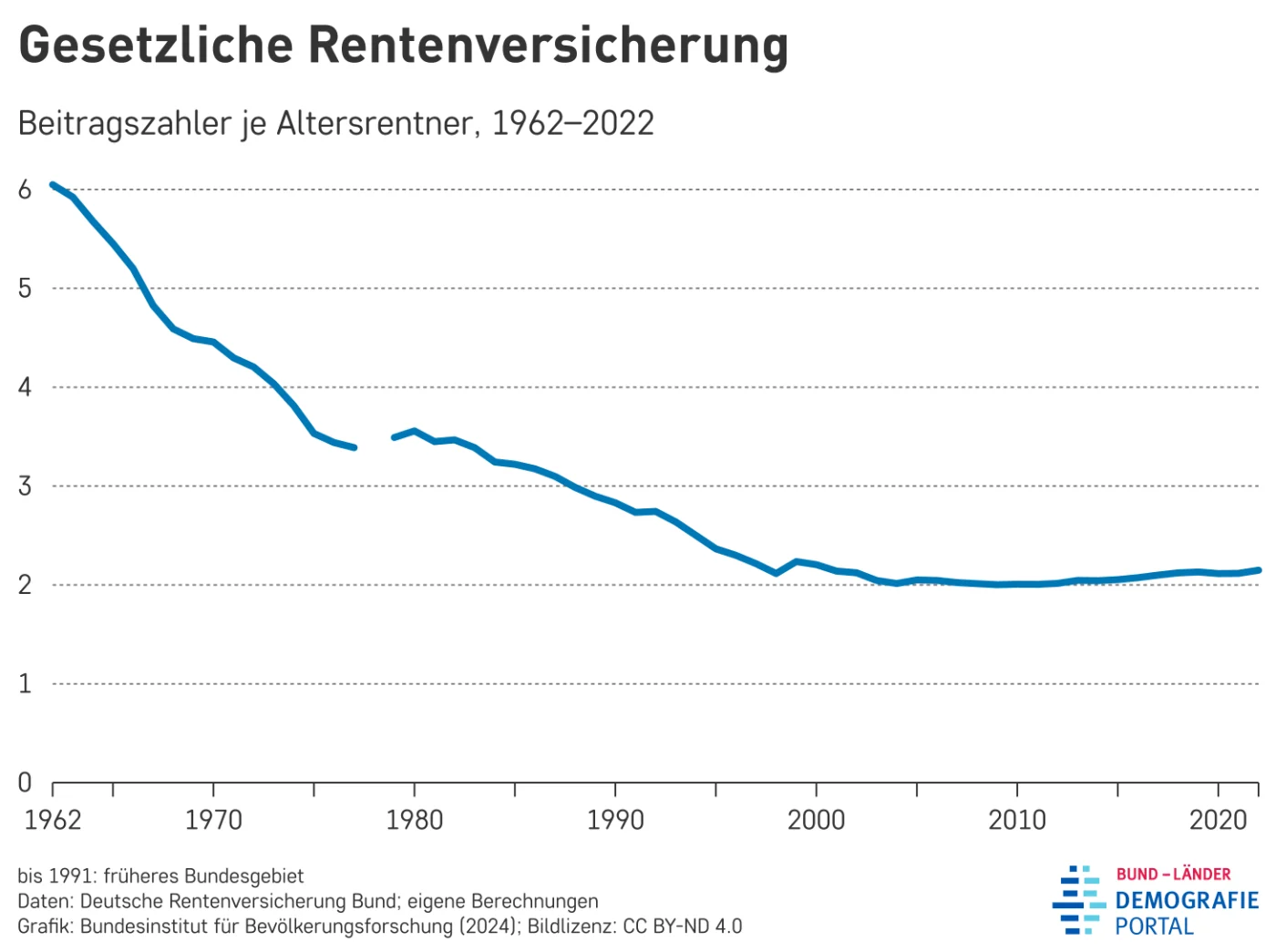
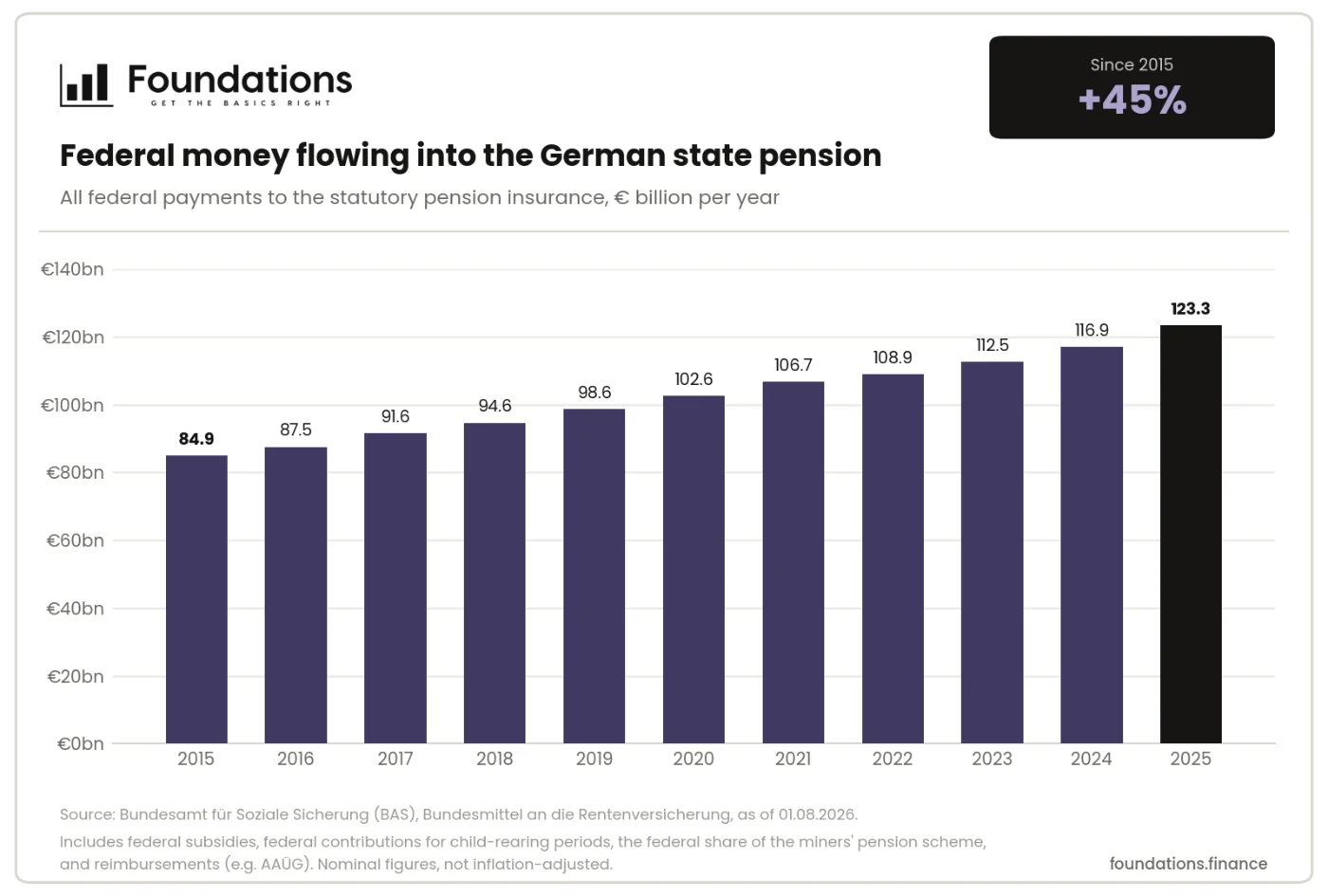
As a result, the system is not self-sustained; the contributions made by employees are simply not enough to cover the system's needs.
In reality, money has to be constantly injected into the system. A lot of money, and it's constantly increasing:
An unfunded system: what you accumulate is not an asset, just a claim
The German state pension system is based on a pay-as-you-go mechanism. The money you pay in is not invested on your behalf. In fact, it's not invested at all. It's used immediately to pay this month's allowances to retirees.
There are also no individual accounts, and your paid-in money no longer belongs to you: it's flowing into a shared pot.
What we get is a downward spiral: if population growth is much slower than before (or if it's even shrinking), there are fewer and fewer people (proportionally) paying into the system. At the same time people live longer and therefore even more money is required. Lastly, the whole system is cash-based - if funds are not invested, they cannot appreciate in value. The only thing keeping it afloat is federal payments used to cover the missing piece, and the annual adjustment to the value of each point (which is, in itself, a political decision, which makes it less predictable and definitely not guaranteed).
I wrote about it in detail in my Low, lower, German state pension blog post. The essence of it is that effectively, in most cases, it's similar to, if not worse than, just accumulating cash:
Average annual return providing the same gross monthly amount as state pension under various salary scenarios and various withdrawal rates
| Salary Scenario/SWR | 3.0% | 3.5% | 4.0% | 4.5% | 5.0% |
|---|---|---|---|---|---|
| Low-earner | 3.2% | 2.4% | 1.7% | 1.0% | 0.4% |
| Conservative | 3.3% | 2.4% | 1.6% | 0.9% | 0.2% |
| High-earner | 3.3% | 2.4% | 1.5% | 0.8% | 0.05% |
| Maximum | 3.2% | 2.4% | 1.7% | 1.0% | 0.4% |
For expats, there are other relevant aspects, such as the minimum period and what happens if you leave Germany. I cover them in Part 6: Leaving Germany.
Sources
- Pension points: § 70 SGB VI
- Average salary (Durchschnittsentgelt): § 69 SGB VI and Anlage 1 SGB VI
- Contribution ceiling: § 159 SGB VI
- My analysis: Low, lower, German state pension
This guide is general information, not personal financial advice. Please read the disclaimer.