
TL;DR
- Private pension insurance is a long-term contract with an insurer, without any state subsidy. Its main selling point is lighter taxation of the payouts.
- Costs are high: acquisition costs of 2.5–5% of all planned contributions, plus ongoing fees for the whole term.
- These products are almost always sold by commission-paid brokers; just under 1% of financial advisors in Germany are independent (including yours truly).
- Even with the tax advantage, a typical plan pays less in retirement than a low-cost ETF portfolio built with the same money.
The first two pillars happen largely without your involvement: whether you like it or not, if you're an employee the state pension is deducted from your salary automatically. bAV is often opt-in, but in larger companies it's usually offered by your employer as part of the onboarding, and set up through your employer. The third pillar, however, is different. It’s everything you do on your own to save for retirement, by choice and on your own initiative.
In Germany, “private pension” usually doesn’t mean simply putting money aside. It means signing a contract, typically with an insurance company, that collects your money for decades and then pays it back to you in retirement.
This part covers the classic private pension insurance, plus the two older state-supported products, Riester and Rürup. The new Altersvorsorgedepot (Riester 2.0), which replaces Riester for new contracts from 2027, has its own part: Part 4: The Altersvorsorgedepot.
What it is
A private pension insurance (private Rentenversicherung) is a long-term contract with an insurance company. You pay in regularly, the insurer invests the money, and from retirement it pays you a monthly pension for as long as you live, or a lump sum, depending on the contract. Anyone can sign one, there’s no state subsidy, and it’s the product you’re most likely to be offered when you talk to a financial broker in Germany.
There are three basic types
Classic: the insurer invests your money in its own general portfolio, mostly bonds, and credits you a (low) guaranteed interest rate plus a variable share of its surpluses.
Fund-linked (fondsgebunden): your money goes into investment funds or ETFs chosen within the contract, with or without a guarantee.
Hybrid and index-linked: combinations of the two, designed to offer some market exposure while keeping a guarantee.
The main selling point is the tax treatment in retirement. If you take your money as a monthly pension, only a portion of each payment is taxed (Ertragsanteilsbesteuerung), and that portion depends on your age when the pension starts (for example, only 17% is taxed if you start at 67). If you take a lump sum, half of the gains are tax-free, provided the contract ran at least 12 years and you’re at least 62 (Halbeinkünfteverfahren).
Why it’s almost always sold, not bought
I'm quite certain (though I don't have definite proof) that nobody, not even one person, ever walked into an insurance company and asked for a private pension. These products are sold, through brokers, insurance agents and bank advisors. Understanding how that works is the key to understanding the product itself.
At the time of writing, there are 41,895 registered financial consultants and brokers in Germany. Only 396 of them are independent, fee-only advisors (§34h). That’s just under 1%. The other 99% are paid by commission: they don’t charge you for their advice, but they earn money from the insurance companies and fund providers whose products they sell.
I’m not saying all brokers are dishonest. But their income depends on selling products, so the products have to carry enough fees to pay for that commission. And those fees are paid by you, just not upfront and not visibly. As I put it in TANSTAAFL: if you’re not paying for it, you’re the product.
What it really costs
The cost structure typically includes some or all of these:
One-time acquisition costs: usually 2.5% to 5% of all contributions planned over the entire term. On a plan with €500 a month for 30 years, that’s €180,000 in planned contributions, and 2.5% of that is €4,500, just for signing the contract. These costs are usually deducted from your first five years of contributions, which is why so little builds up in the early years.
A percentage of every contribution: up to 10%, so of every €100 you pay in, only €90 may actually be invested.
A percentage of your accumulated balance: charged every year, usually even after you’ve retired.
Fixed annual fees: often a low double-digit amount.
Fund costs: for fund-linked products, the fees of the funds inside the contract come on top.
This might not sound like a lot, but it is. In TANSTAAFL I looked at one of the best plans I’d come across, with total costs of 1.11% per year. Assuming a 7% market return, €500 a month over 30 years would grow to €479,979 in that plan, against €566,711 in low-cost ETFs costing 0.2% per year, under the same conditions. That’s a difference of about €87,000, and it was one of the good plans.
Costs are only part of it. Products with a guarantee have an additional, less visible drag. To be able to promise you a minimum amount, the insurer has to keep a large share of your money in safe, low-yielding investments, which means less of it ever works for you in the markets. (Part 2 explains this mechanism in detail for the bAV; it works the same way here.)
What happens when you retire
Naturally, the sales pitch focuses on the payout phase ("You'll only pay taxes on 17% of your allowance and the rest is tax free!") so it’s worth looking at what you actually get there.
The monthly pension is set by the insurer. Your contract will usually guarantee a minimum amount from the start, but the final figure depends on how the insurer converts your accumulated money into a monthly pension, which is calculated on conservative assumptions about how long you’ll live, with costs continuing throughout. For you, this is one of the least transparent parts of the whole contract.
Granted, the tax advantage is real. But it's not enough. Only a small part of each payment is taxed, and that’s one of the strongest arguments brokers use. But as I showed in TANSTAAFL Part II, even with that tax advantage, the net monthly income from a typical plan still ends up lower than what you could withdraw from an ETF portfolio built with the same money:
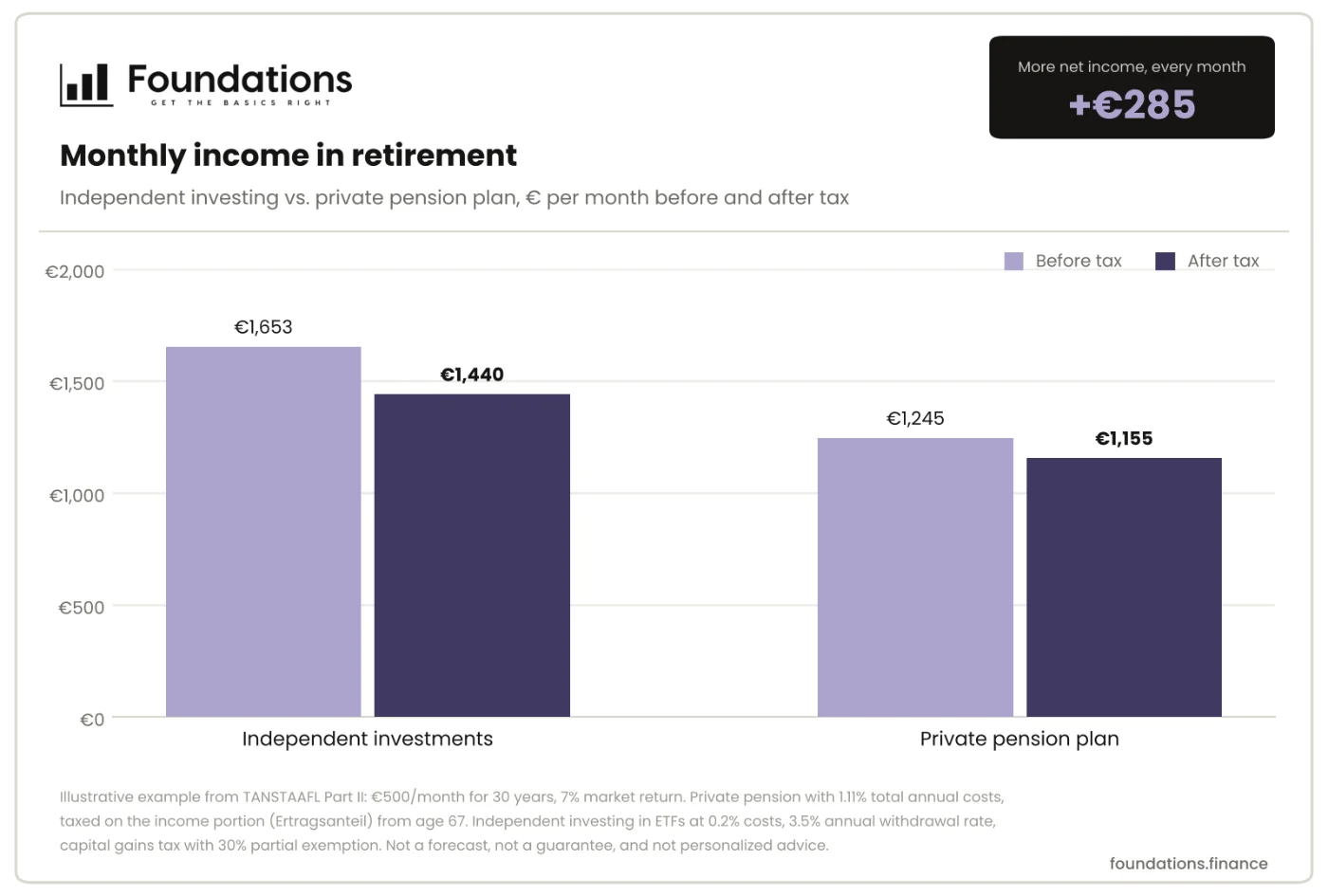
The logic is simple. A company that has to make a profit stands between you and your investments. To make up for its costs, it would have to either generate better returns than you could on your own, which it can’t, or offer tax advantages large enough to cover the difference, which they aren’t.
What you do get in return
There's really only one scenario in which I believe it would make sense to prefer a private pension plan over independent investing: if you truly believe that you're not capable of managing it by yourself, and you're willing to pay a lot of money to outsource it. And if, even after getting some neutral, independent consulting, you still believe the whole thing is too complicated for you and it's worth paying this much for having someone else manage it for you.
Before you sign anything
If you’re considering a private pension insurance, ask for:
- The total costs in euros, not just percentages: acquisition costs, ongoing costs and fund costs over the full term.
- The effective costs, and the return assumption they’re based on. (See Part 2 for why this figure alone can be misleading.)
- The guarantee level, and what the non-guaranteed part is actually invested in.
- What happens if you stop paying, cancel early, or leave Germany.
- How your monthly pension will be calculated, and how much of it is actually guaranteed.
- How your advisor is paid. If it’s by commission, keep that in mind when you hear the recommendation.
If you can’t get clear answers to these questions, that is an answer in itself.
Riester 1.0: if you already have a contract
Riester was introduced in 2002 to make up for cuts to the state pension: insurance-based contracts with direct state subsidies, a strict guarantee, and limited access to your money. From 2027, it’s replaced by the Altersvorsorgedepot for new contracts (see Part 4).
Existing contracts are protected: you can keep paying in and keep receiving the subsidies, and from 2027 you’ll also be able to move your contract into the new system. There’s no need to act in a hurry. But if your contract is expensive, it’s worth having it reviewed by someone who doesn’t earn a commission on whatever you do next.
Be wary of “last chance” pitches: until 31 December 2026, new Riester contracts can still be signed, and some providers are actively marketing exactly that. Given what’s coming in 2027, there’s rarely a good reason to sign one now.
For expats in particular: moving outside the EU can mean paying back the subsidies you’ve received. More on that in Part 6: Leaving Germany.
Basisrente (Rürup)
The Basisrente, often called Rürup after its designer, is a private pension aimed mainly at the self-employed, who aren’t covered by the state pension. Its appeal is a generous tax deduction on contributions. In return, it’s the strictest product on the market: the money can only ever be paid out as a lifelong monthly pension. No lump sum, no cancellation, no selling or borrowing against it, and on death it can only pass to a spouse or children as a survivor’s pension.
That makes it a permanent decision. Before committing, get independent advice. Also note that the new Altersvorsorgedepot will open state-subsidised saving to the self-employed for the first time, which gives you a more flexible alternative to compare against.
Sources
- Taxation of the monthly pension (Ertragsanteil): § 22 EStG
- Taxation of lump sums (half the gain): § 20 Abs. 1 Nr. 6 EStG
- Basisrente (Rürup): § 10 Abs. 1 Nr. 2 b EStG
- My analysis: TANSTAAFL and TANSTAAFL Part II
This guide is general information, not personal financial advice. Please read the disclaimer.